Problem Description
有一只经过训练的蜜蜂只能爬向右侧相邻的蜂房,不能反向爬行。请编程计算蜜蜂从蜂房a爬到蜂房b的可能路线数。
其中,蜂房的结构如下所示。

Input
输入数据的第一行是一个整数N,表示测试实例的个数,然后是N 行数据,每行包含两个整数a和b(0<a<b<50)。
Output
对于每个测试实例,请输出蜜蜂从蜂房a爬到蜂房b的可能路线数,每个实例的输出占一行。
Sample Input
2
1 2
3 6
Sample Output
1
3
这是一道递推的题,观察给出的图形,只有上下两行,容易想到1→2,3→4相当于一样的走法,这就涉及减法相同的问题了。那就只考虑从1到别的蜂房,1→2 1→3 1→4 1→5分别输出1 2 3 5,这就是斐波那契数列了,直接上代码:
1
2
3
4
5
6
7
8
9
10
11
12
13
14
15
16
17
| #include <stdio.h>
int main(void){
int t;
long long f[55];
f[1]=1;
f[2]=2;
for(int i=3;i<55;i++){
f[i]=f[i-1]+f[i-2];
}
scanf("%d",t);
while(t--){
int n,m;
scanf("%d%d",&n,&m);
printf("%lld\n",f[m-n]);
}
return 0;
}
|
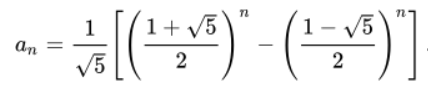
或者使用斐波那契数列的通项公式来求,不过要注意公式中n的取值,因为数列:1 1 2 3 5 ……,我们不需要第一项。
1
2
3
4
5
6
7
8
9
10
11
| #include <stdio.h>
#include <math.h>
int main(void){
int n,a,b;
scanf("%d",&n);
while(n--){
scanf("%d%d",&a,&b);
printf("%.0f\n",1.0*(pow((1+sqrt(5))/2.0,b-a+1)-pow((1-sqrt(5))/2.0,b-a+1))/sqrt(5));
}
return 0;
}
|